
· Ivelin Kozarev · Sales Coaching · 8 min read
What Does AI Actually Do for Sales Coaches?
AI does not replace a sales coach's methodology. It helps coaches assess faster, run practice at scale, and prove results without adding headcount.
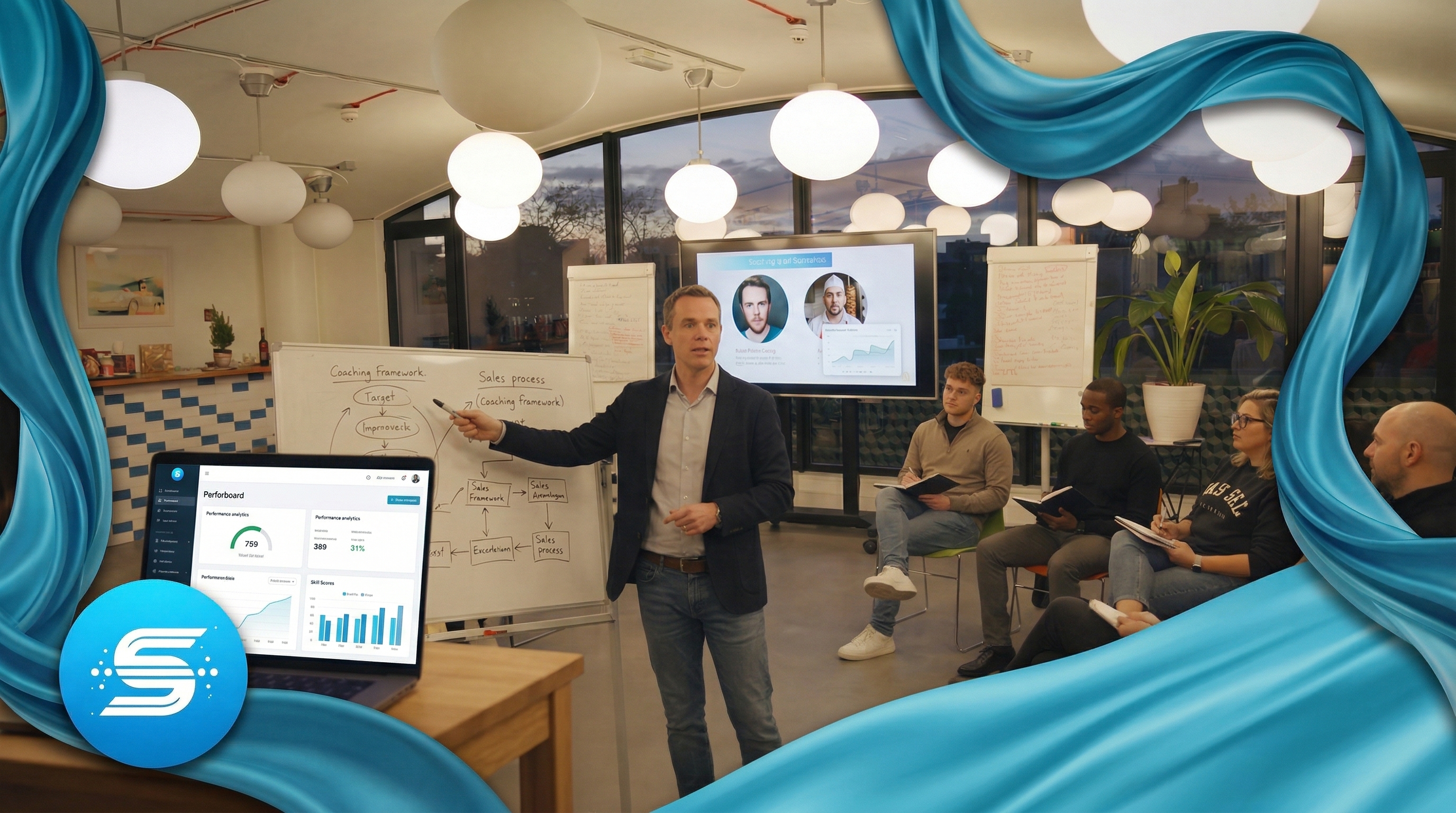
AI does not replace a sales coach’s methodology. It helps coaches scale the three parts of the job they already own: assessment, practice, and proof.
If you work with sales teams and are trying to understand where AI fits, start with this framing: AI is not a new methodology. It is a delivery layer that helps you coach more people well, more consistently, without turning your calendar into the bottleneck.
If you want to see how this fits the wider market, explore the Sales Coach Hub or our page on sales coaching software for sales trainers.
What Do Sales Coaches Already Do Well?
The best sales coaches already follow a strong three-phase process: assess the team, run the sessions, prove it worked. That cycle - diagnosis, delivery, measurement - is what separates real coaches from people who show up, present for two hours, and hope something sticks.
Phase 1: Assess. You figure out where the gaps are. Maybe it is discovery calls. Maybe it is objection handling. Maybe the team talks too much and never lets the buyer think. You find the problem before you prescribe the fix.
Phase 2: Deliver. You run the workshops, the role-plays, the live practice. This is where behavior changes. Not from slides, but from reps trying something uncomfortable and getting feedback in real time.
Phase 3: Prove. You show the client what moved. Call scores improve. Conversion rates shift. Ramp time drops. You close the loop so the engagement is not just “everyone liked the training.” It is “here is what changed.”
This process works. It is why good coaches stay booked and get referrals.
But the limitation is not your methodology. It is not your frameworks or your ability to read a room. The ceiling is simpler and more frustrating: there is only one of you.
Why Do Coaches Hit a Capacity Wall?
Because coaching is a one-to-many problem stuck in a one-to-one delivery model. The method works, but every step still depends on the coach’s personal time. Time does not scale.
Before the engagement, you are listening to calls, reading CRM notes, and diagnosing where reps struggle. That is manageable when a client has 10 reps. When they have 200, you are either sampling a tiny fraction of the data or spending weeks on discovery.
During the engagement, the bottleneck gets even more obvious. Live role-play is one of the highest-impact things a coach can do, but you can still only work with one rep at a time. A two-day workshop might give each person a few minutes of individual practice while everyone else watches.
After the engagement, most coaches quietly give up on the proving-it-worked part. Building proper results reports takes hours per client. So it either does not happen, or it turns into a vague before-and-after survey that proves almost nothing.
| Coaching phase | Manual approach | What breaks at scale |
|---|---|---|
| Before (assessment) | Listen to calls, review CRM data per rep | Impossible beyond small teams; you sample or skip |
| During (training) | Live 1:1 role-play in workshops | Each rep gets minimal practice time |
| After (proving ROI) | Manual reporting, surveys, anecdotal evidence | Hours of work per client, so most coaches stop doing it |
The ceiling is not skill. It is arithmetic.
How Does AI Fit Into the Coaching Process?
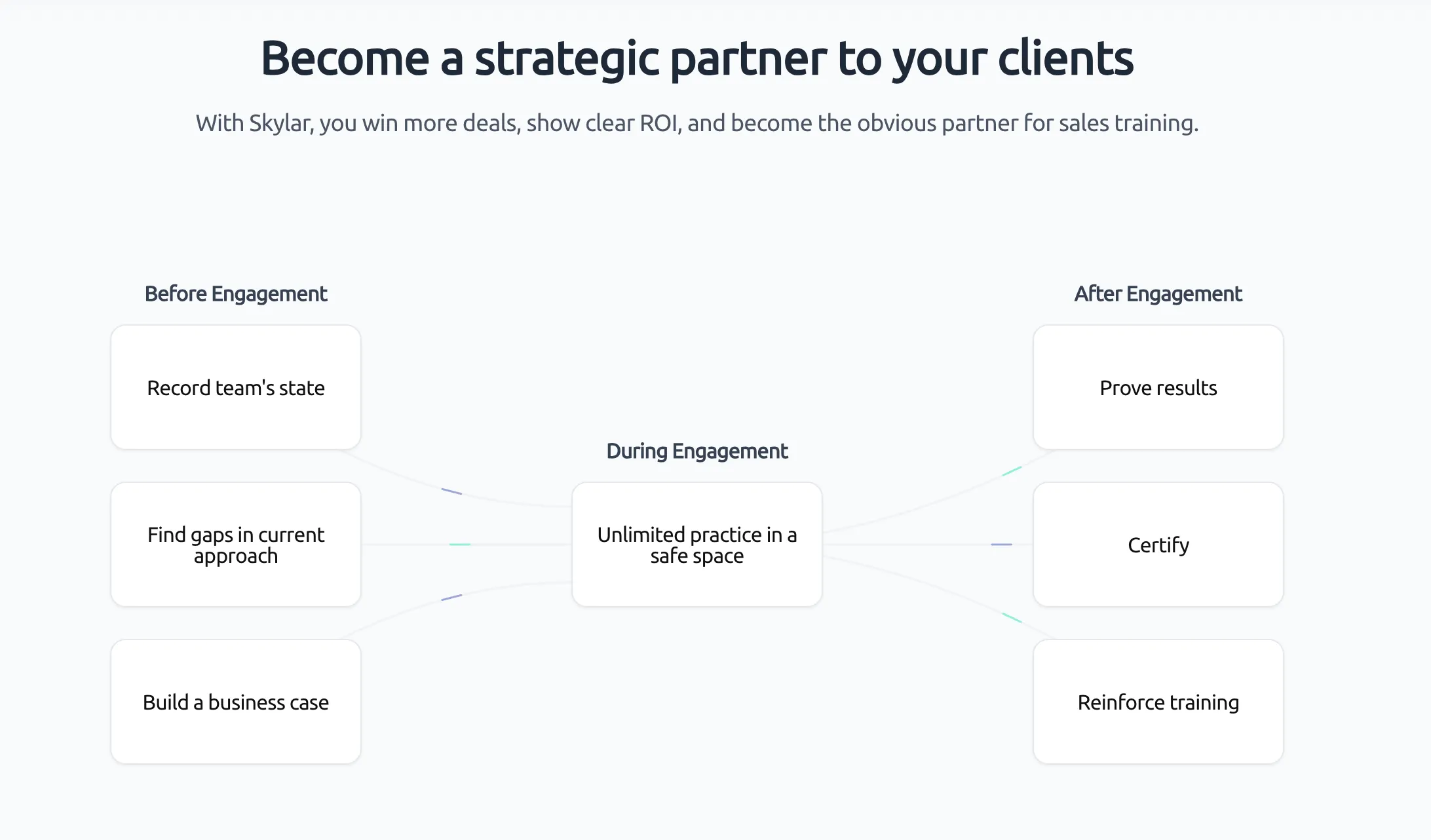
AI does not add new steps. It maps directly onto the three phases coaches already run - assessment, practice, and measurement - and removes the bottleneck in each one.
- Assessment, before training starts. Instead of guessing where reps struggle, AI tools can analyze real conversations and score them against the methodology you already teach. You walk into the engagement with a skills baseline instead of a rough impression.
- Practice, between and after live sessions. This is where the math changes. AI-powered role-play lets every rep practice the scenarios you design, on their own schedule, with feedback tied to your framework. One coach’s methodology, delivered across an entire team at once.
- Measurement, proving what changed. After the program, AI can compare post-training conversations against the original baseline. Did discovery improve? Did objection handling get sharper? Did reps change behavior in the moments that matter? You get evidence, not anecdotes.
Notice what is missing from that list: anything fundamentally new. No extra methodology. No “AI-native coaching model.” No need to rethink what already works.
Same process. Assess, practice, measure. Just without the old capacity wall.
For a practical example of how this plays out in delivery, read How Sales Trainers Are Adding AI Practice to Their Workshops.
Why Is “We Already Do This” the Right Starting Point?
Because it means you already have the hard part: the methodology.
AI does not ask you to become a different kind of coach. It gives you a better way to deliver the coaching you already know works.
A coach who says, “We already do role-play,” is sitting on a serious advantage. They know what good looks like. They know how to score it. They know which behaviors actually move the needle. AI just removes the bottleneck of the coach needing to be in the room every single time.
The real gap in the market is not between coaches who “get AI” and coaches who do not. It is between coaches who have a proven methodology and coaches who are winging it. AI can scale a strong process. It cannot invent one.
So the shift is operational, not philosophical. You stop asking, “Should I use AI?” and start asking, “Which parts of my delivery should I automate, and which parts still need me?”
Usually the answer is obvious. The repetitive parts - practice reps, scoring consistency, progress tracking - are where AI earns its keep. The judgment calls, the read-the-room moments, the conversations where a human coach changes everything? That is still your job.
What Changes for the Business?
When a coach adds AI to their delivery, three things usually shift: capacity, revenue model, and proof.
Capacity stops being the bottleneck. AI practice reps happen without you needing to be in the room. That means you can support larger teams without scaling headcount at the same rate.
Revenue becomes more recurring. Most coaching engagements end when the workshop ends. But when reps are practicing between sessions, and you are the one providing that layer, you are not selling a one-off event anymore. You are selling an ongoing service.
You finally have proof that is not a survey. Instead of asking whether people found the training valuable, you can show who practiced, how they performed, and where they improved. That makes renewals easier and pricing conversations stronger.
If you want the broader business case for training firms, Getting Started with Skylar: A Guide for Sales Trainers goes deeper on capacity, differentiation, and protecting your methodology.
What Is the Risk of Staying Manual?
AI is not coming for your job. But staying manual while competitors find ways to scale? That is a real risk.
Every coach who scales without technology hits the same ceiling. More clients means more prep, more sessions, more follow-up, and eventually more burnout. The math never changes.
AI helps by taking over the parts that are not the coach’s highest-value work in the first place: repetitive practice reps, data collection, and before-and-after measurement that clients increasingly expect.
Your real edge was never “I can run a lot of sessions.” It was judgment, methodology, and knowing what to say when a rep is stuck in a real conversation.
The better question is whether you want to spend your time on admin or on the work that made you valuable in the first place.
Frequently Asked Questions
Does AI replace the need for a sales coach?
No. AI can run drills, but it cannot design the playbook. A coach brings judgment, strategy, and the ability to read a room. AI handles the repetitive practice reps between sessions. Think of it like a batting cage: useful for repetition, useless without a coach behind it.
What parts of sales coaching can AI automate?
Role-play practice, call scoring, and progress tracking. These are the high-volume, repetitive tasks that eat a coach’s calendar. AI handles them between live sessions so coaches can focus on strategy, deal reviews, and the work that requires a human.
How does AI help coaches serve larger clients?
Enterprise clients want proof and scale. AI gives you both. You can run practice across a full sales team and collect skill data on every rep. You walk into reviews with performance metrics instead of anecdotes.
Do coaches need technical skills to use AI tools?
No. Most modern AI coaching tools are built for non-technical users. In practice, setup usually means uploading your methodology, scenarios, and scoring criteria. Your expertise matters more than technical skill.
What is the difference between AI coaching and human coaching?
AI coaching is practice at scale. It runs reps, gives instant feedback, and never gets tired. Human coaching is pattern recognition, emotional intelligence, and strategic thinking. The best setup uses both: AI for volume, humans for judgment.