(updated ) · Alexandra Kozareva · Sales Training · 3 min read
How Sales Trainers Are Adding AI Practice to Their Workshops
Workshops are high-energy events. But what happens before and after is a black box. Here's how trainers are using AI practice to change that.
You deliver a great workshop. The room nods. People take notes. Energy is high.
Then everyone goes back to their desks. Without follow-up practice, it can be hard to tell who is applying what they learned.
This isn’t a content problem. Your framework is solid. But hearing a framework and using it are two different things. Without practice, knowledge stays theoretical. And theoretical knowledge doesn’t close deals.
By the time reps are back on calls, your session is competing with inbox fires and quota pressure. Give them a specific behaviour to practise and a time to review it.
Here’s how trainers are fixing this — before, during, and after the workshop.
For the broader coaching process, start with what AI actually does for sales coaches. To prepare your first programme, use our AI roleplay starter guide for sales trainers, including a buyer brief and sample scoring rubric.
Before the workshop
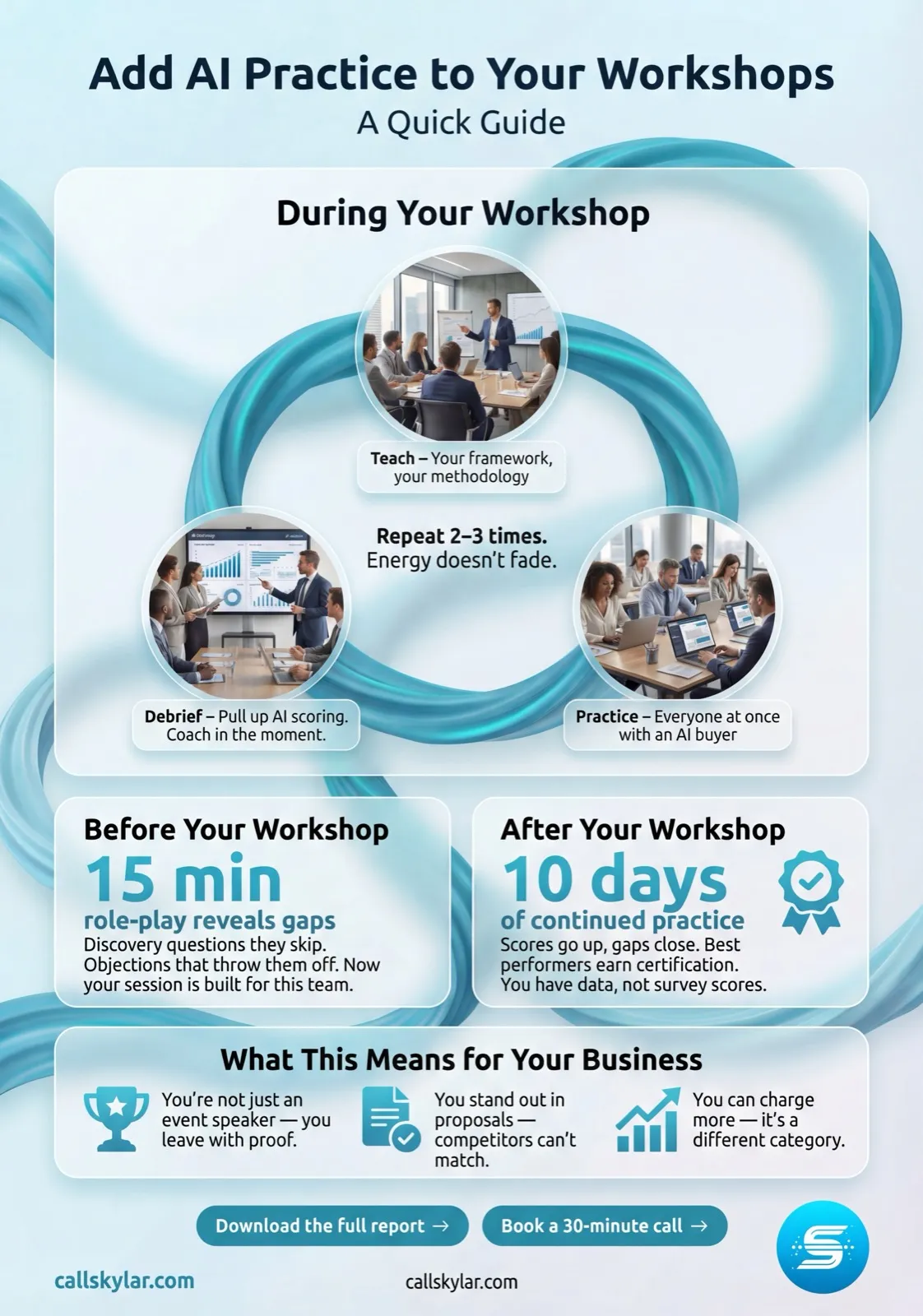
A few participants complete a 15-minute AI role-play before the session.
You see what they struggle with. Not in the abstract — in actual conversation. The discovery questions they skip. The objection that throws them off. The close they never attempt.
Now your session is built for this team. Not a generic audience.
You walk in knowing exactly where they need help. That changes the whole dynamic.
During the workshop
This is where it gets interesting.
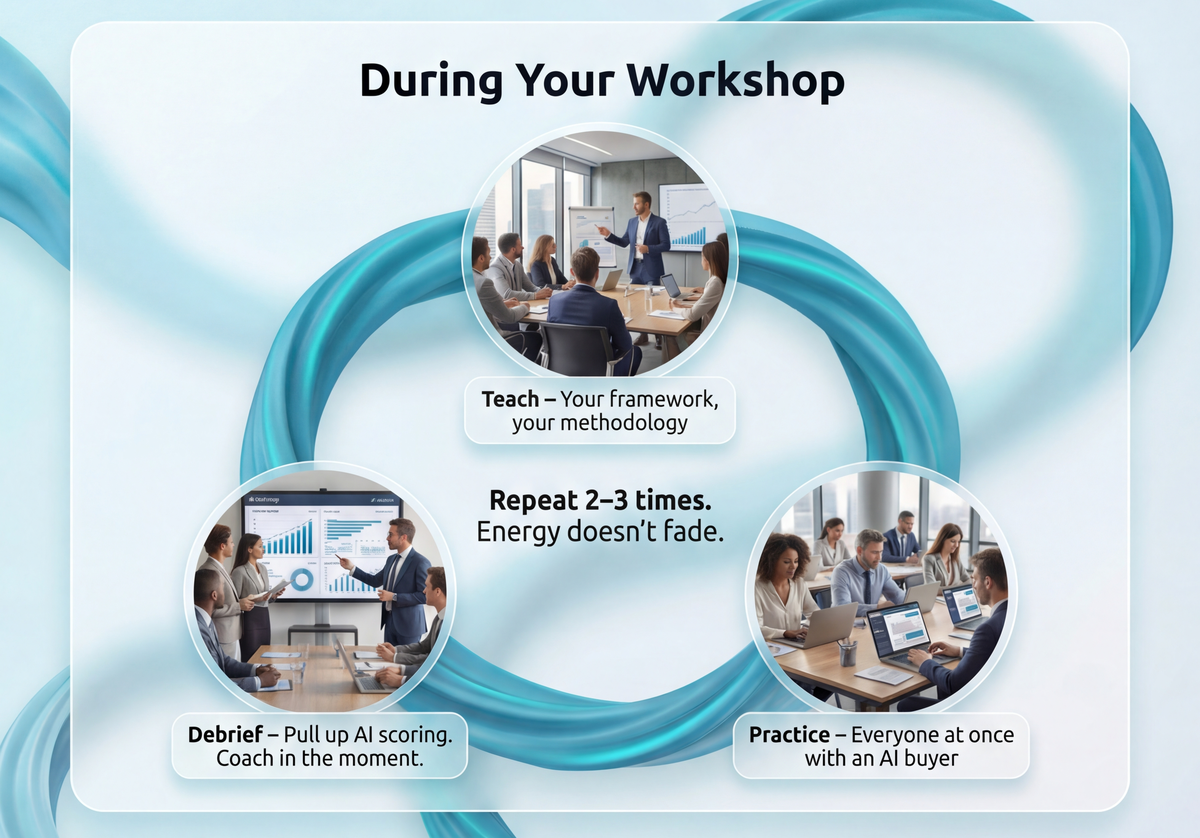
Instead of teaching for 90 minutes and hoping it lands, you break the session into teach, practice, debrief cycles:
- Teach a concept — your framework, your methodology.
- Everyone practices at once — participants run a role-play with an AI buyer, applying what you just taught. Not one volunteer while others watch. Everyone.
- Debrief together — pull up examples from the AI scoring. “Here’s what Sarah did well on the objection. Here’s where Marcus got stuck.” Coach in the moment, with real attempts to reference.
Repeat 2–3 times in a half-day session.
The room stays active. Energy doesn’t fade after hour one. And you’re coaching off real practice, not hypotheticals.
Add leaderboards or team competitions during practice rounds. Friendly pressure keeps engagement high.
After the workshop
Participants keep practicing for 10 more days.
You see the improvement: scores going up, gaps closing, skills that were shaky in the workshop now landing consistently.
Best performers earn certification. When the client asks “did this work?” — you don’t have survey scores. You have data.
What this means for your business
You’re not just an event speaker. You show up with baseline data, run an interactive session, and leave with proof of improvement. That’s a different conversation with buyers.
You stand out in proposals. “Every participant practices and gets scored feedback” is a line your competitors can’t match.
You can charge more. Interactive training with before/after data is a different category than “a workshop.” Price accordingly.
This is one of five plays
This workshop play is from our report: 5 Ways Training Companies Are Using AI to Generate More Revenue Right Now.
The report covers four more plays — from post-workshop analytics to paid assessments to building a “digital you” coach bot. Each one with the mechanics, step by step, and the revenue angle.
For another example of how firms are using this, read the AI sales training case studies.