· Ivelin Kozarev · Sales Coaching · 4 min read
What 7,500 Roleplays Taught Us About Helping Sales Reps Improve
We analysed over 7,500 roleplays on Skylar. One thing surprised me — it’s not about how much reps practise.

We just finished analysing over 7,500 roleplays to find what makes the biggest difference in how much reps improve. One thing surprised me - it’s not about how much they practise.
What did not surprise me is that sales reps focus on their scores after a roleplay. A lot.
Naturally, we score them on many things.
Trying to get everything right
Think about an intro call. We can score discovery, pitch, how they close. All of these are important.
A sales rep sees those scores and tries to get everything right on the next attempt. Often, they put as much preparation into it as they would a real call.
This is NOT what you want.
When reps do this, their scores do improve. But slowly and inconsistently. Some scores go up, some go down.
The preparation makes sense. So does wanting to run a good call. But look at what we’ve asked the rep to work on: better questions, deeper discovery, a more relevant pitch and a stronger close. All on the next attempt.
As a coach, you might already have one thing you want them to work on. The scorecard gives them several.
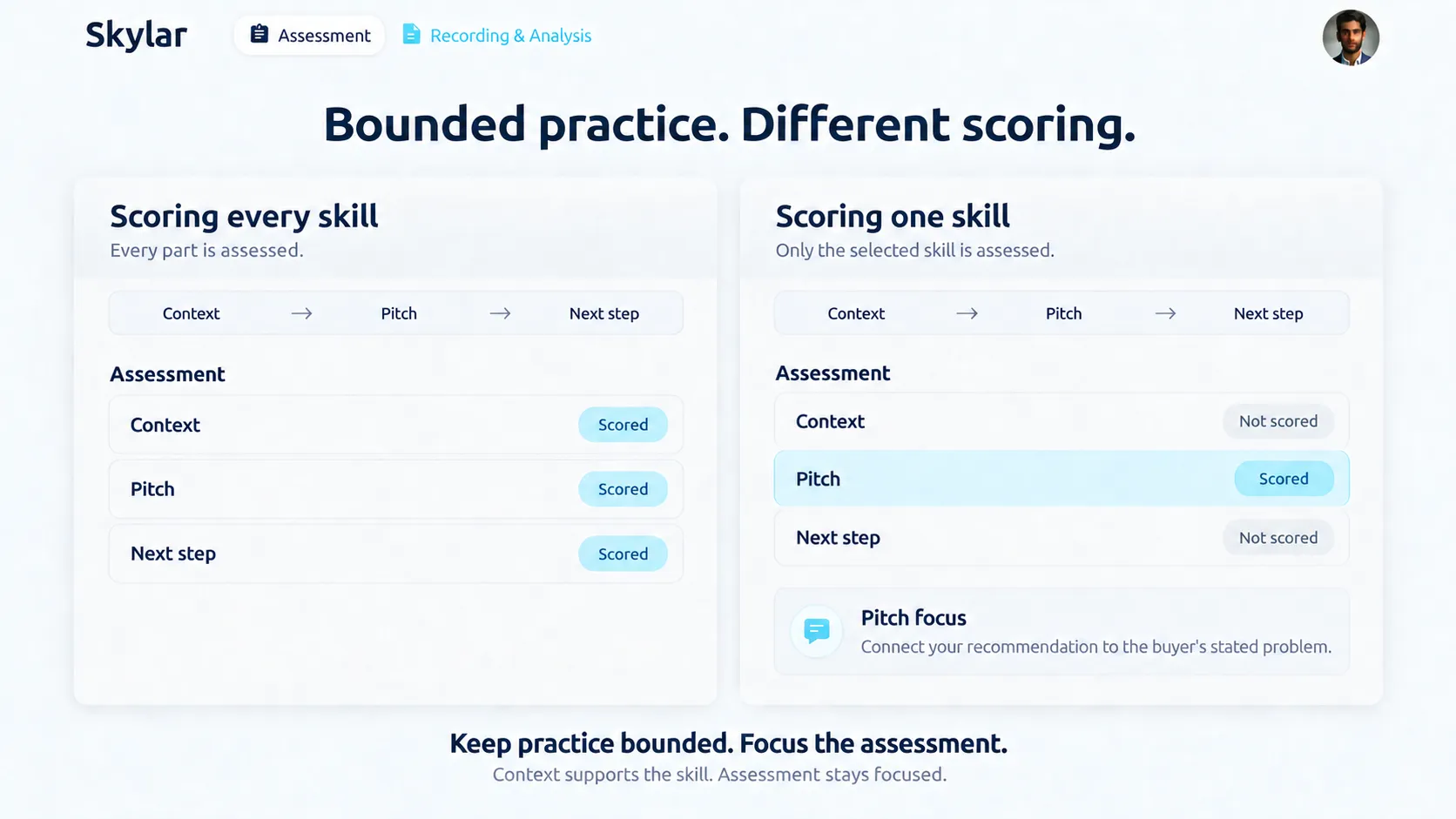
Keep the practice bounded. Focus the scoring.
This is what works instead:
- Set up a bounded roleplay with the context the skill needs. A pitch drill may include a little discovery so the rep has something real to respond to, but it does not need to run every stage of a full sales call.
- Only score one part, e.g. the pitch. Tell the rep what you’re assessing before they start.
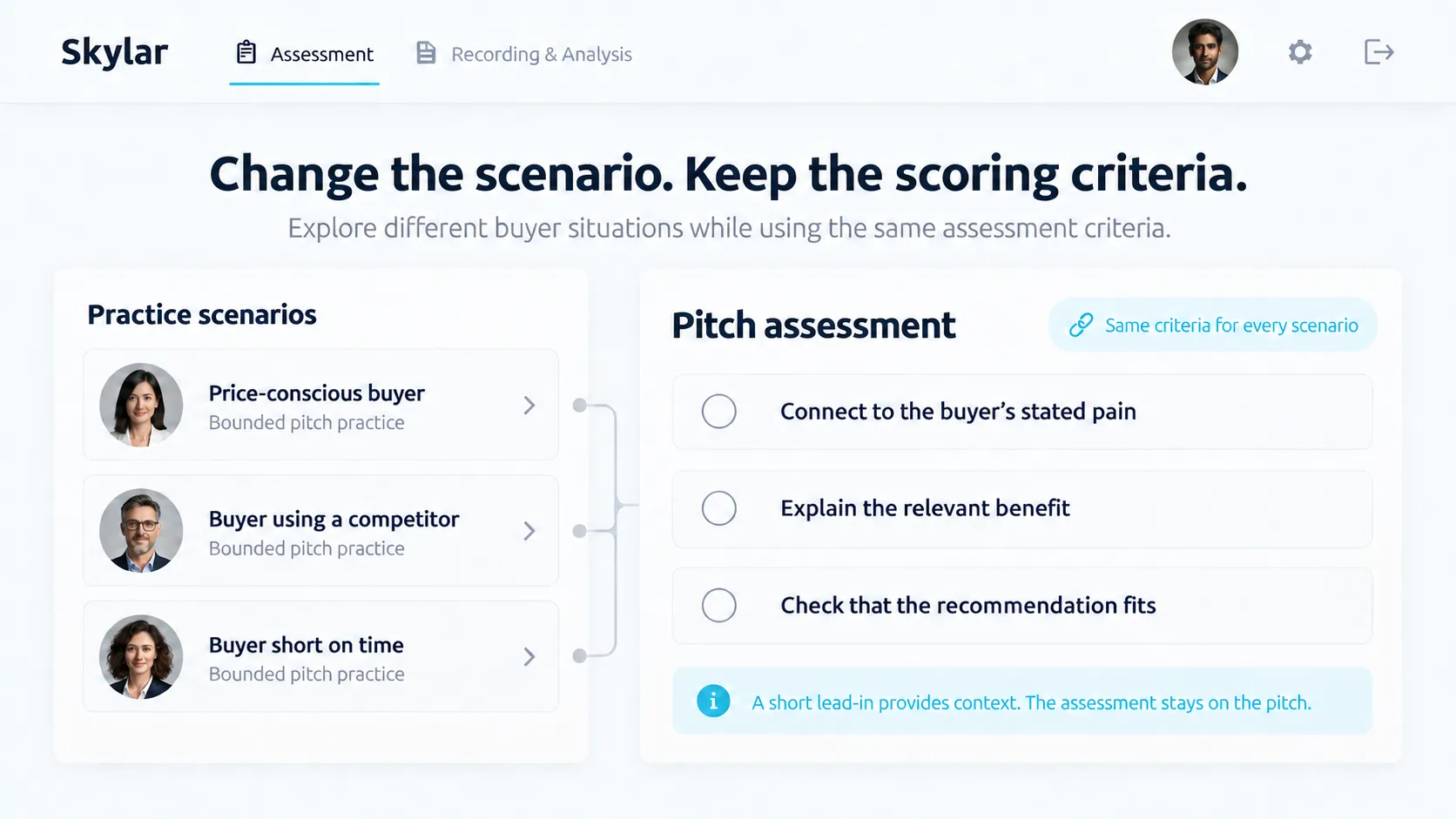
- Vary parts of the roleplay, but keep the scoring the same. Change the buyer or the situation while keeping the same criteria for a good pitch.
This is not an argument for a long, end-to-end call simulation. Keep the scenario tight around the moment you want to improve. We can’t isolate things completely, of course.
For example, if you haven’t done a bit of discovery, you won’t be able to have a great pitch. You need something to connect your recommendation to.
But we are only scoring you on the pitch.
The rep needs the context required to demonstrate the target skill. They just have a clear answer to “what am I trying to get better at this time?”
What this looks like in practice
Say you’re coaching reps to connect their pitch to the buyer’s problem. You could assess whether they:
- Connect the recommendation to the pain the buyer actually described.
- Explain a benefit that matters to that buyer.
- Check whether the recommendation fits.
Those are examples. Use the criteria that match how you teach a good pitch.
On the next attempt, change the situation. The buyer might have a different problem, different priorities or less time to talk. Keep assessing the same skill, using the same criteria.
Now the rep has to adapt their pitch to what they hear. Repeating the same words won’t get them through every conversation.
And your feedback has a clear focus: what worked in that pitch, and what to change on the next attempt.
What we saw in the roleplays
We saw reps scored on one skill improve 160% MORE than reps scored on multiple skills.
And the improvements were still there 4 weeks after the last time reps had practised.
That’s the part I’d want to pay attention to as a coach. Getting a better attempt today is useful. Seeing the improvement still there weeks later matters too.
For your next practice session, pick one skill you want reps to improve. Keep the scenario bounded, make the scoring focus clear and keep those criteria consistent as you vary the scenarios.
Yes, it does feel like you’re going slower. But as they say, you have to walk before you can run. Crawl before you can walk. Roleplay before you can sell. Whatever.
More insights soon.
For more practical ways to build roleplay into your coaching, visit the Sales Coach Hub or read our guide to turning group coaching into targeted roleplay practice.