
Step 1
Run group coaching
Coach the team on one shared skill, behaviour, or conversation pattern.
Group coaching
Use Skylar to connect group coaching, assigned practice, real conversation trends, and session-specific roleplays into one repeatable client offer.
This is a coaching loop product: run group coaching, assign practice, use AI to find real conversation trends, coach the pattern, then launch targeted roleplays for the next behaviour change.
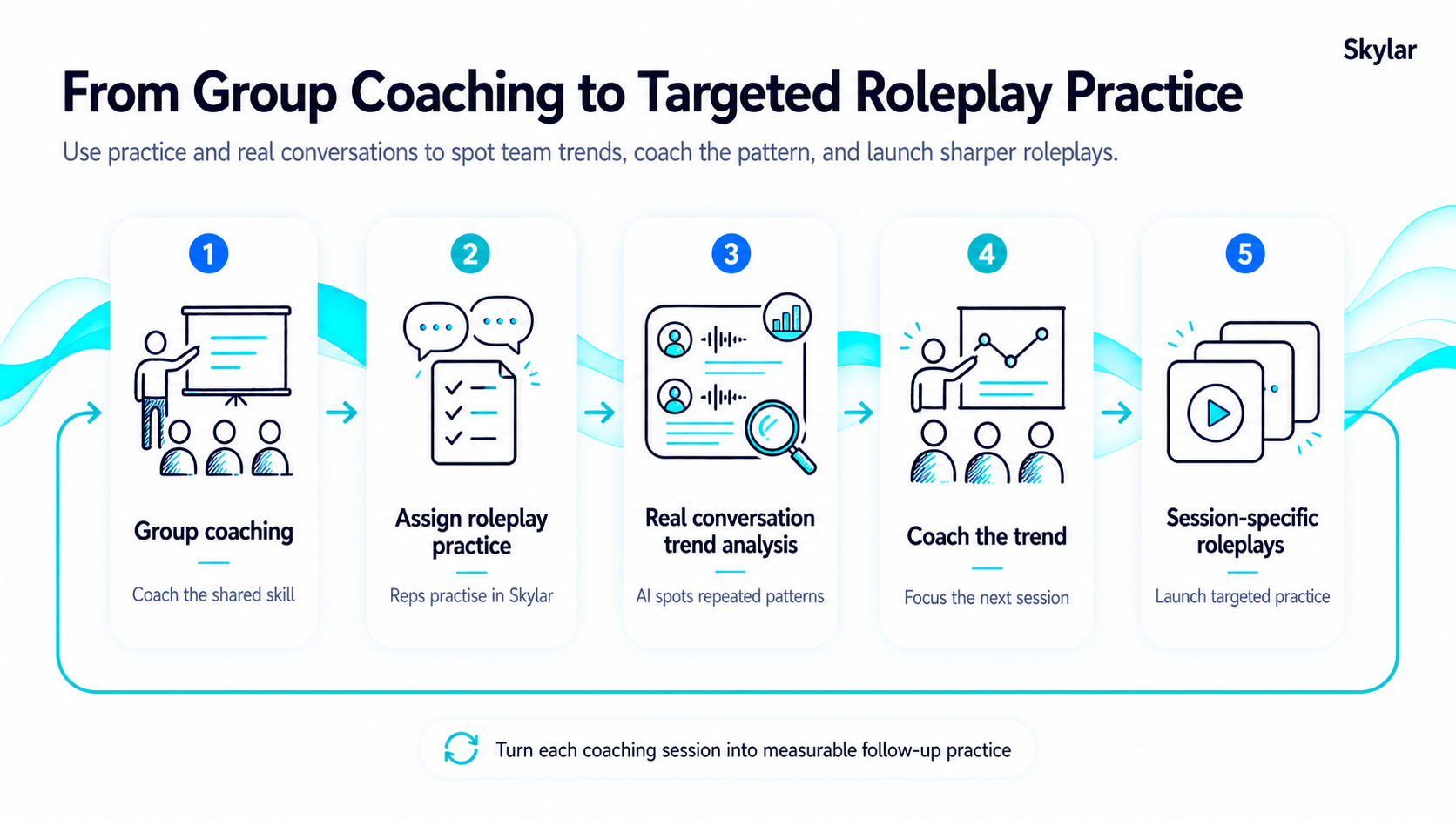
Most group coaching creates useful discussion, but the follow-through is often generic. This model gives coaches a clearer product. The session creates the theme. Skylar practice gives reps a place to rehearse. Real conversations show the trend. The coach then turns that evidence into targeted practice before the next session.
Step 1
Coach the team on one shared skill, behaviour, or conversation pattern.
Step 2
Send reps into Skylar practice so the coaching does not end when the session ends.
Step 3
Use AI to spot repeated patterns in real conversations, not just in practice scores.
Step 4
Create session-specific roleplays that practise the exact trend the coach wants to change.
Facilitation
The value is not just assigning more roleplays. It is using real conversation evidence to decide what the next roleplay should be, so the coach can keep the work specific.
Sell it as a coaching loop, not a single group coaching session.
Start each session with one clear behaviour the team needs to improve.
Use Skylar practice to create a first signal, then use real conversations to confirm the trend.
Coach the pattern back to the group with examples, not vague feedback.
End by launching roleplays that are specific to that coaching session and the trend you found.
Use the next trend as the agenda for the next coaching session.
Short answers for coaches packaging trend-led group coaching as a repeatable service.
A deal clinic starts with one live deal and turns it into a group lesson. This model starts with group coaching, then uses Skylar practice and real conversation trends to decide what the team needs to practise next.
Roleplay shows whether reps can practise the skill in a controlled setting. Real conversations show whether the behaviour is actually changing with customers. The coach needs both signals.
The coach uses the trend to focus the next session: what the team is repeating, where the behaviour breaks down, and what specific conversation move needs to be rehearsed.
They come after the coaching session. Instead of assigning generic practice, the coach launches roleplays built around the exact trend covered in that session.
Speak with Skylar about connecting group coaching, real conversation trends, and session-specific roleplays.