
Step 1
Module content
Give learners the lesson, framework, or behaviour standard they need to understand.
Course delivery
Use Skylar to turn each course module into a practice loop: learn the content, roleplay the scenario, receive scored feedback, and progress only when the learner can apply the skill.
The practical course model is a sequence of module content, AI roleplay, scored feedback, progress gates, and certification evidence.
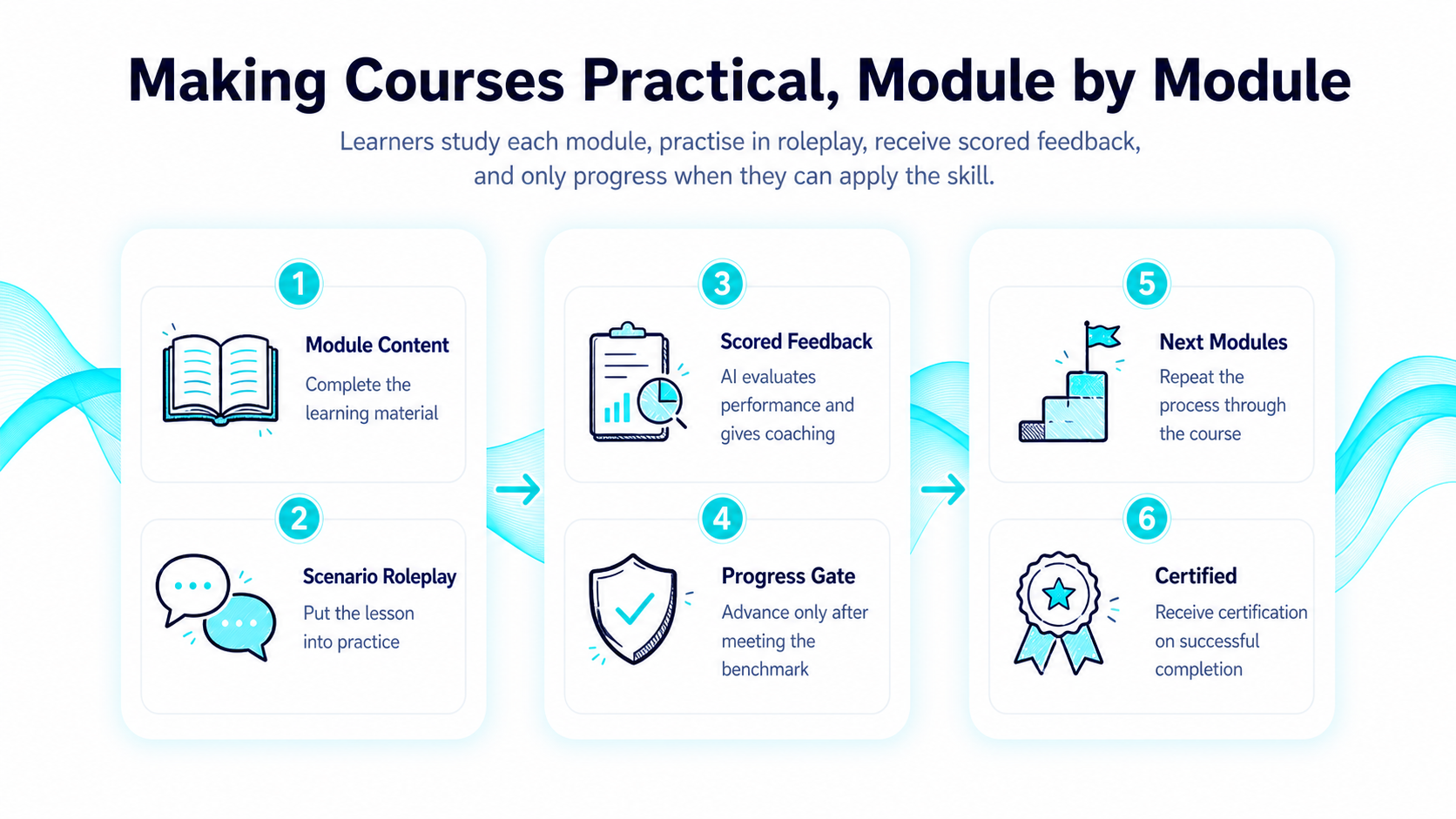
This model is useful when a course needs to become more than content access. It helps coaches sell a stronger client offer because progress is tied to behaviour, not just completion.
Step 1
Give learners the lesson, framework, or behaviour standard they need to understand.
Step 2
Turn the module into a realistic Skylar practice scenario so learners apply the idea quickly.
Step 3
Use AI evaluation to show what the learner did well and what still needs work.
Step 4
Advance learners only when they meet the benchmark for the skill.
Step 5
Repeat the loop through the course until the learner can apply the full method.
Step 6
Use completion evidence to support certification, client reporting, or internal readiness.
Delivery
The client should be able to see who practised, who improved, and where the cohort still needs coaching. That evidence makes the course easier to renew, extend, or package as a premium programme.
Keep each module focused on one behaviour learners can practise and measure.
Write scenarios from the client context, not generic sales theory.
Set the progress benchmark before learners begin the module.
Use completion data to show clients who is ready, who needs support, and which skills are improving.
Short answers for coaches adding practical gates to course delivery.
Courses often prove that learners consumed content. Roleplay proves whether they can use the skill in a conversation.
A progress gate is a clear benchmark learners must meet before moving forward. It keeps the course practical because advancement depends on demonstrated skill, not just attendance.
Yes. The same model works for self-paced courses, cohort programmes, and blended client academies. The coach can review the data between sessions and focus live time where learners are stuck.
Certification becomes more defensible when it includes roleplay attempts, scored feedback, and evidence that learners met the required standard across modules.
Speak with Skylar about adding roleplay, scored feedback, and progress gates to your course delivery.