· Ivelin Kozarev · Sales Technology · 7 min read
AI Sales Role-Play Platform Buying Criteria: A Practical Scorecard
Compare AI sales role-play platforms with a weighted scorecard, a shared demo brief, and a pilot that tests feedback quality, adoption, data controls, and total cost.
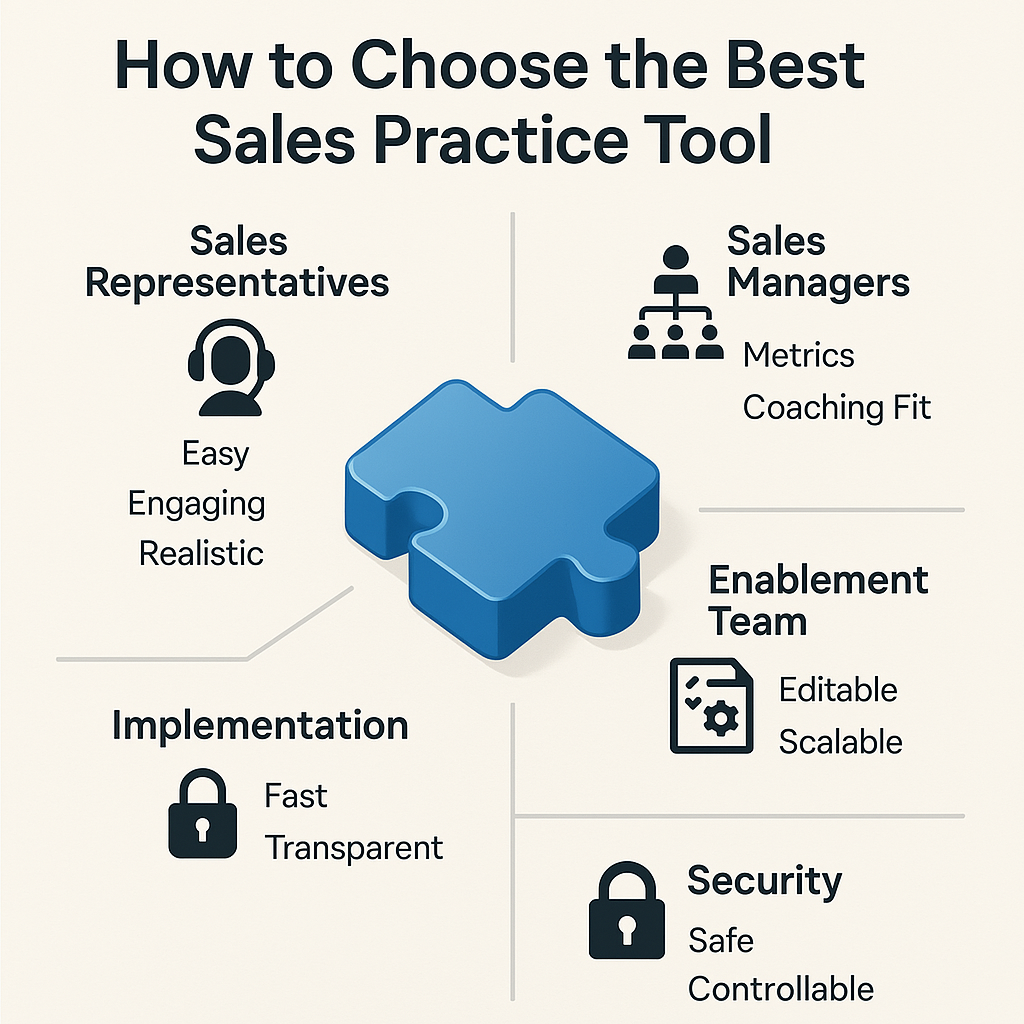
Choose an AI sales role-play platform by testing your own scenarios, your own scoring criteria, and the workflow your team will actually use. Compare the evidence from those tests with a scorecard. A polished demo should earn a place in your pilot, not decide the purchase.
The checks below cover reps, coaches, managers, and the person who runs the program. They are our recommended evaluation method, not results from a vendor benchmark.
If you run a coaching business, start with what sales coaches should consider before buying AI roleplay. That guide covers the service model and client commitments. This one helps you test the tools on your shortlist.
Set your pass-or-fail requirements first
Some requirements cannot be traded for a nicer voice or a lower price. Write them down before watching demos.
For example, you might require separate client workspaces, a contract that meets your data requirements, a way to export results, and feedback tied to your coaching rubric. Mark a requirement as essential only when you can explain what would break without it.
Ask the vendor to show each requirement in the plan you would buy. A feature on the roadmap does not count as available today. Where a requirement depends on a contract, review the contract as well as the product.
Give each vendor the same demo brief
Use a scenario that exposes the skill you teach. Here is an illustrative brief, which you can adapt:
A rep is speaking with an operations director who wants fewer delivery delays but has not shared their cost. The director is wary of another software project. The rep needs to explore the impact, identify who else is involved, and agree on a useful next step. The rep should not pitch a solution before understanding the problem.
Give every vendor the same buyer facts, difficulty level, and scoring rules. Run three kinds of attempt:
- A weak attempt: the rep pitches early and accepts vague answers.
- A strong attempt: the rep follows up, checks their understanding, and earns a next step.
- A mixed attempt: the rep uses the right phrases but misses the buyer’s actual concern.
The third test matters. A system that rewards keywords can look good on an obvious good-versus-bad comparison. It needs to distinguish a useful conversation from a checklist recital.
Use a weighted platform scorecard
These weights are a suggested starting point. Set them before you compare vendors, and adjust them to fit your program. Keep essential requirements outside the total: a high score cannot cancel a failed requirement.
Score each area from 0 to 4:
- 0: cannot do what you need.
- 1: vendor says it can, but you have not verified it.
- 2: works in a guided demo, with clear gaps or workarounds.
- 3: your team completes the task during a pilot.
- 4: your team repeats it successfully in the conditions you need, with little help.
| Area | Weight | Evidence to collect |
|---|---|---|
| Feedback and scoring | 25% | Scores distinguish the three attempts; feedback cites the conversation and gives a useful next action. |
| Scenario and rubric control | 20% | Your coach edits the buyer, difficulty, and scoring rules without rebuilding the program. |
| Learner experience | 15% | Reps can join, complete an attempt, understand feedback, and try again on their normal devices. |
| Coach and manager workflow | 15% | A reviewer finds a skill gap, checks the evidence, and assigns the next practice without a manual spreadsheet exercise. |
| Data and administration | 15% | Required access controls, exports, retention terms, and client separation are verified. |
| Cost and delivery effort | 10% | A written quote and measured setup time cover the way you plan to use the platform. |
Calculate each weighted score as rating ÷ 4 × weight, then add them for a total out of 100. Record the evidence and any gap beside each rating. The total supports your decision; it does not replace judgment.
Worked example: when the higher score should still lose
The following figures are invented to show how the scorecard works. They do not describe real vendors or customer results.
| Area | Weight | Platform A rating | Platform B rating |
|---|---|---|---|
| Feedback and scoring | 25 | 4 | 3 |
| Scenario and rubric control | 20 | 4 | 3 |
| Learner experience | 15 | 3 | 3 |
| Coach and manager workflow | 15 | 3 | 3 |
| Data and administration | 15 | 2 | 3 |
| Cost and delivery effort | 10 | 3 | 3 |
| Weighted total | 100 | 82.5 | 75 |
Platform A has the better total. But suppose it fails your essential requirement for separate client access. You should not select it for a multi-client coaching program until that gap is resolved and retested. Platform B remains eligible; you still need to decide whether its cost and performance justify buying.
Test whether the feedback matches your coaching
Ask a coach to score the sample attempts before looking at the AI scores. Compare the two sets of judgments at the level of each skill, rather than just the final number.
For each disagreement, ask:
- Did the system cite something the rep actually said?
- Did it miss a follow-up question or misunderstand the buyer?
- Is the scoring rule too vague?
- Would the feedback help the learner do something different on the next attempt?
- Can the coach review and address a misleading result?
Repeat some attempts to see whether the conclusions remain usable. Do not expect identical scores from every run. Do expect a sound explanation for decisions that affect your coaching.
Our guide to what AI actually does for sales coaches explains where automated practice fits and where a coach still needs to make the call.
Check the whole workflow, not just the conversation
A rep needs to get from an invitation to useful feedback. A coach needs to turn that feedback into the next lesson. An administrator needs to keep the program running.
During the pilot, measure the time spent on those tasks. Ask a rep to use their normal device and network. Ask a coach to change an objection, update the rubric, and find the learners who need help. Ask an administrator to add a cohort and remove access when it ends.
Short practice can make scheduling easier, but there is no universal session length that guarantees adoption. Test a length that fits the skill and the learners’ working day. Track where people stop, what blocked them, and whether they return after seeing the feedback.
Review data controls and the full price
Request written answers on recordings, transcripts, scores, uploaded training material, and account information. These can have different storage and deletion rules.
Check who can access each data type, which providers process it, whether it is used to train models, where it is stored, how long it is retained, and what happens when the contract ends. Have the appropriate person review the terms for your business and clients. A security badge alone does not answer these questions.
For cost, include:
- Seats, active-user rules, usage limits, and overage charges.
- Setup, scenario creation, coach training, and support.
- Reporting, integrations, client workspaces, and branding where needed.
- Your own hours spent administering the program.
- Renewal terms and the work needed to export or migrate content.
Compare costs for the same expected workload. A cheap seat price can become expensive when your team has to maintain everything by hand.
Agree on pilot acceptance criteria before starting
Use a small real cohort and one clear skill. Choose a review date, name the decision owner, and write down what would lead you to buy, revise the pilot, or stop.
Here is a practical acceptance template:
| Question | Agree before the pilot | Record at the review |
|---|---|---|
| Can learners use it? | Required devices, access steps, and your target for completing assigned practice. | Completion counts, failed attempts, and reasons learners stopped. |
| Is feedback usable? | Rubric, sample size for human review, and how disagreements will be handled. | Examples of accurate and misleading feedback, plus unresolved issues. |
| Does skill improve? | Baseline task, comparable final task, and who will review both. | Changes in the target behavior, including learners who did not improve. |
| Can coaches run it? | Maximum setup and weekly review time your service can support. | Actual hours, support requests, and workarounds. |
| Does it meet the buying requirements? | Essential controls, budget, and contract requirements. | Evidence for each requirement and any remaining gap. |
A higher practice score alone is not proof of higher sales. Repeated attempts may teach the learner the exercise. Check whether the behavior transfers to a fresh scenario and, when appropriate, to work that a manager can observe.
For a rollout plan, use getting started with AI roleplay for sales trainers. If you cannot yet name the skill, the program owner, or the time for practice, review when to invest in an AI sales role-play platform before buying.